5 Tips for Buying a 5kW Lithium Battery?
Buying a 5kW lithium battery requires more than comparing online prices. The label can hide important differences. A battery’s power rating, measured in kilowatts, shows how much electricity it can deliver at once. Its capacity, measured in kilowatt-hours, shows how long it may run your appliances. Many buyers confuse these figures. I did too when comparing early product specifications.
This guide explains five practical checks for choosing a suitable system. It covers usable capacity, inverter compatibility, battery chemistry, safety documentation, and long-term value. A Battery Au Lithium 5kw system may appear attractive, but its performance depends on the complete installation. Check whether the inverter supports the battery voltage and communication protocol. A mismatch can reduce efficiency or create avoidable service problems. Ask for independent test reports, warranty conditions, and clear information about cycle life. Marketing language is not enough.
Think about a real evening at home. A refrigerator, router, lights, and induction cooker may operate together. Their combined demand can exceed expectations, especially during motor start-up. Review your electricity data before selecting storage. Professional installers should assess cable sizing, ventilation, switchgear, backup requirements, and local grid rules. They should also explain what the warranty excludes, including extreme temperatures or poor maintenance. Even careful advice has limits. Household usage changes, and solar production varies with weather. A reliable purchase leaves room for those uncertainties rather than promising perfect energy independence.
Define Your 5kW Lithium Battery Energy and Power Requirements
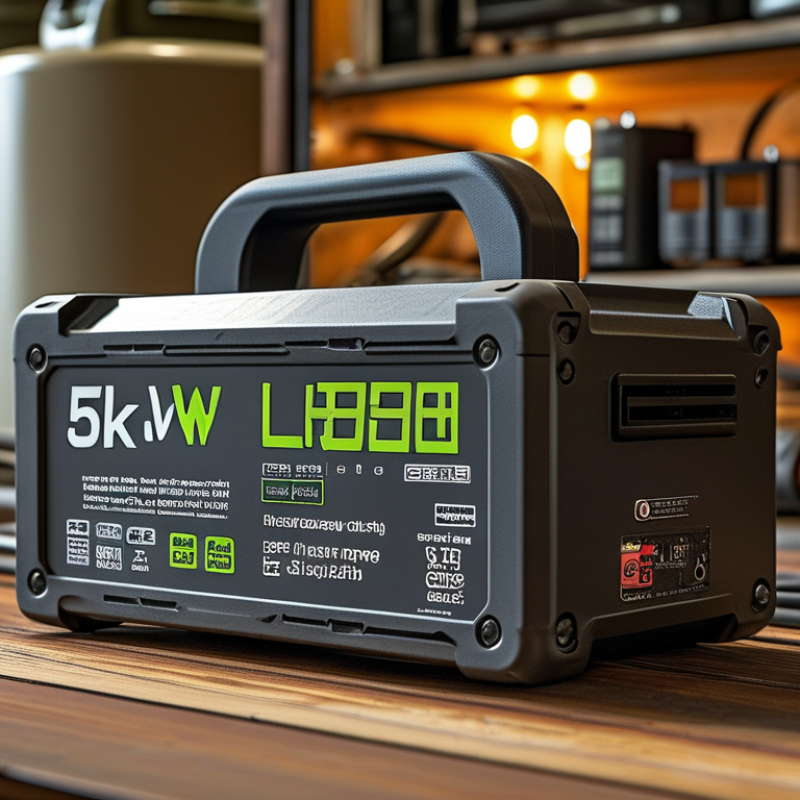
A 5kW lithium battery specification can be misleading. The 5kW figure usually describes maximum power, not stored energy. Power determines which appliances can run together. Energy, measured in kilowatt-hours (kWh), determines how long they operate.
List every intended load, including refrigerators, pumps, lights, and communication equipment. Record each appliance’s running wattage and starting surge. A pump rated at 1,000W may briefly demand twice that amount. Add the running loads, then check the inverter’s continuous and surge ratings. A 5kW system may not start several motors safely. That detail matters.
Estimate energy by multiplying each load’s kilowatts by its operating hours. For example, a 1kW heater running for four hours needs about 4kWh. Include inverter losses, cold-weather performance, and the battery’s usable depth of discharge. A practical calculation may require 5kWh or more. Leave a sensible reserve. It protects against cloudy weather, aging cells, and unexpected demand.
In field assessments, users often underestimate evening consumption. They remember appliance ratings but forget standby devices. I have made that mistake too. A power meter used for several days can reveal real household patterns. Review the highest simultaneous load and the longest backup period separately. They are different design questions. Also confirm charging power, installation temperature, ventilation, and certified protection equipment before purchase.
5 Tips for Buying a 5kW Lithium Battery? - Define Your 5kW Lithium Battery Energy and Power Requirements
| Tip |
Requirement to Define |
Practical Example |
Key Calculation or Specification |
Buying Guidance |
| 1 |
Separate power from energy |
A 5 kW load requires power; the desired operating time determines energy capacity. |
Power = 5 kW
Energy for 2 hours = 5 kW × 2 h = 10 kWh
|
Do not select a battery only because it is described as “5 kW.” Confirm both its continuous power rating and its usable energy in kWh. |
| 2 |
Match usable energy to runtime |
For a 5 kW load, a 51.2 V, 100 Ah battery provides approximately 5.12 kWh nominal energy. |
Nominal energy = 51.2 V × 100 Ah = 5.12 kWh
At 90% usable depth of discharge: 5.12 × 0.90 = 4.61 kWh usable
Estimated runtime at 90% inverter efficiency: 4.61 × 0.90 ÷ 5 = 0.83 hours
|
For approximately 2 hours at a 5 kW load, a practical starting point is about 12.3 kWh nominal capacity, allowing for 90% usable discharge and 90% inverter efficiency. |
| 3 |
Check continuous and peak power |
The battery and inverter must support the load continuously, while motor-driven equipment may require short-term surge power. |
Continuous load: 5 kW minimum
Recommended design margin: approximately 6 kW continuous
Surge capability: verify the starting requirement of pumps, compressors, and other inductive loads
|
Choose a battery system whose continuous discharge rating is at least equal to the inverter requirement. Add capacity for startup surges only when the appliance specifications require it. |
| 4 |
Verify voltage and discharge current |
A common high-voltage configuration for a 5 kW inverter is approximately 51.2 V nominal. |
Ideal DC current at 5 kW: 5,000 W ÷ 51.2 V = 97.7 A
Allowing for 90% inverter efficiency: 5,000 W ÷ (51.2 V × 0.90) = 108.5 A
|
Confirm that the battery, busbars, cables, fuse, and battery-management system can safely handle the required continuous current. A system rated near 100 A may have limited margin at full 5 kW output. |
| 5 |
Review operating conditions and safety limits |
Lithium batteries require compatible charging, protection, and installation conditions. |
Confirm: nominal voltage, charge voltage, maximum charge current, maximum discharge current, operating temperature, enclosure rating, and communication compatibility
|
Use a battery-management system with over-voltage, under-voltage, over-current, short-circuit, and temperature protection. Follow the battery manufacturer’s permitted temperature range and installation instructions. |
|
Reference assumptions: Runtime examples use a 51.2 V nominal battery, 90% usable depth of discharge, and 90% inverter efficiency. Actual results vary with load profile, battery temperature, battery age, inverter efficiency, wiring losses, and the battery-management system’s limits.
|
Compare Battery Chemistry, Capacity, Voltage, and System Compatibility
5 Tips for Buying a 5kW Lithium Battery
A 5kW rating describes output power, not stored energy. Check the battery’s usable capacity in kilowatt-hours before purchasing. A 10kWh battery may not deliver all 10kWh, because the recommended depth of discharge protects its cells. For a home using 2kW continuously, runtime could approach five hours, but inverter losses reduce that estimate. Real loads are rarely steady.
Battery chemistry deserves careful comparison. Lithium iron phosphate usually offers strong thermal stability and long cycle life. Nickel manganese cobalt chemistry can provide higher energy density, but temperature control and installation conditions matter more. Review the battery management system, operating temperature range, warranty terms, and tested cycle data. Marketing numbers can look impressive. The small print matters.
Voltage must match the inverter and charging equipment. At 48V, a 5kW load may draw over 100A, so cables, fuses, terminals, and ventilation need proper sizing. Confirm communication protocols, maximum charge current, grounding requirements, and shutdown functions. During system checks, compatibility problems often appear between the battery, inverter, and monitoring interface. I once assumed matching voltage guaranteed compatibility; it did not. Leave room for that mistake. Have a qualified installer verify the complete system before energizing it.
5 Tips for Buying a 5kW Lithium Battery
Compare battery chemistry, capacity, voltage, and system compatibility before selecting a battery for a 5kW load.
1. Compare chemistry
LFP generally offers long cycle life and strong thermal stability. NMC provides higher energy density, while LTO offers very high cycle life but lower energy density.
2. Size the capacity
A 5kW load running for 4 hours needs 20kWh of delivered energy. Allowing for 90% usable depth of discharge and 95% conversion efficiency requires approximately 23.4kWh nominal capacity.
3. Check the voltage
Typical series configurations near a 48V-class system are 16S LFP at 51.2V, 14S NMC at about 51.8V, and 20S LTO at about 46.0V.
4. Confirm compatibility
Verify the inverter's DC voltage range, continuous current rating, charging limits, battery-management-system requirements, and communication protocol.
5. Review real operating conditions
Temperature, charge rate, discharge rate, installation space, safety controls, and expected daily cycling can significantly affect battery performance and service life.
The chart uses representative midpoint values from commonly reported chemistry ranges. Actual performance varies with cell design, operating temperature, charge rate, discharge depth, and battery-management settings.
Check Safety Features, Certifications, Warranty, and Lifespan
A 5kW lithium battery deserves more than a large capacity label.
Check the safety architecture first. Look for a battery management system with overcharge, short-circuit, over-temperature, and deep-discharge protection. Thermal sensors should monitor individual cells, not only the outer case.
Certification matters too. IEC 62619 covers industrial lithium battery safety, while UL 9540A evaluates thermal runaway and fire propagation behavior. UN 38.3 testing is also important for transportation. These standards do not guarantee perfect installation. They show that the product faced defined tests.
Warranty language often reveals more than advertisements.
Confirm the warranty period, cycle limit, minimum retained capacity, and allowable operating temperature. A ten-year warranty may become weak if it covers only limited daily use. NREL’s Storage Futures Study models lithium-ion storage lifetimes commonly around 10–15 years, depending on cycling, temperature, and maintenance.
Real homes can be harsher. Summer heat, poor ventilation, and frequent full discharges accelerate aging. Read the fine print.
I would also compare usable energy, not only the advertised 5kW rating.
A 5kW output rating describes power, while stored energy is measured in kilowatt-hours. Ask for capacity-retention test conditions and service procedures. A small mistake here can be expensive.
A reliable seller should provide test documents, installation guidance, and a clear replacement process. Even then, published cycle figures may not match daily reality. That uncertainty deserves an honest margin.
Select a Reliable Supplier and Verify After-Sales Support
When buying a 5kW lithium battery, clarify the specification before comparing prices. A 5kW rating usually describes output power, while storage capacity is measured in kWh. Ask whether the unit can deliver 5kW continuously or only for short peaks. Request test data, usable capacity, cycle life, operating temperature, and compatible inverter details.
Supplier reliability matters just as much as battery chemistry. Ask for a written warranty with clear coverage, exclusions, claim procedures, and response times. A vague promise is not enough. Verify the supplier’s business registration, technical certificates, installation records, and customer references. Speak with one recent buyer if possible. Details reveal more than polished brochures.
After-sales support should be tested before payment. Send practical questions by email and measure how clearly the team responds. Confirm who handles remote diagnosis, replacement parts, firmware updates, and safety inspections. Ask whether support remains available after the installer leaves. Written procedures matter. Also check the service location and expected repair timeline. A low price may become expensive if one failed component stops the system for weeks. I would also request a commissioning report showing voltage, communication settings, and protection limits. Buyers sometimes overlook this step. That is a mistake worth reconsidering. Keep every document, including invoices, serial records, manuals, and service messages. Clear records make future warranty discussions faster.